FinTech Weekly - Clarity Circle - The Blockchain's Biggest Irony - Issue #1 Friday, March 27th 2026 06:00PM
THE LEAD
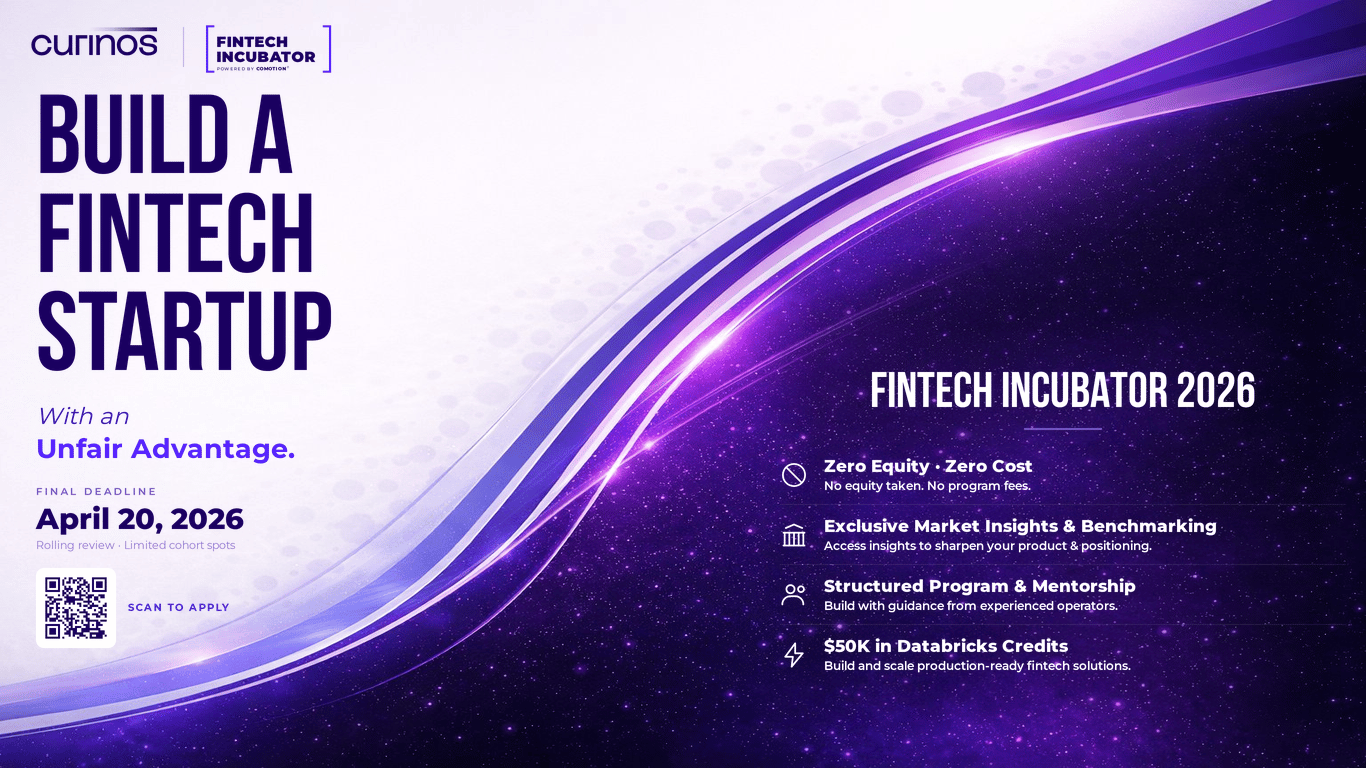
THE CURINOS FINTECH INCUBATOR — 2026 COHORT
The Curinos FinTech Incubator is built around exactly that gap. A 12-month, zero-equity program powered by CoMotion at the University of Washington and backed by Curinos' proprietary benchmarking data across banking, lending, and pricing — the same data financial institutions use internally.
The 2026 cohort is open to pre-Series A startups across decision intelligence, inclusion, analytics, personalization, lending, deposits, and digital banking, registered in the US or Canada.
Applications close April 20, 2026. APPLY below!
Applications are open for the 2026 Curinos FinTech Incubator — a 12-month, zero-equity program for early-stage fintech startups building data-driven solutions in financial services.
Powered by CoMotion at the University of Washington and backed by Curinos' proprietary financial data and industry expertise, the program has already incubated 3 startups from its inaugural cohort — giving founders direct access to the tools, networks, and insights that financial institutions actually use.
What you'll get:
- Direct mentorship from Curinos leaders and industry experts
- Exclusive market insights and benchmarking tools across banking, lending, and pricing
- Guidance on product strategy, value proposition, and commercialization
- Insight into how financial institutions evaluate, buy, and deploy fintech solutions
- CoMotion Labs membership: coworking, UW resources, and startup community
- Up to $50K in Databricks credits, plus technical support and training
- Early-stage fintech startups across decision intelligence, inclusion, analytics, personalization, lending, deposits, or digital banking
- Pre-Series A, legally registered in the U.S. or Canada
Introducing the FLAIR 200
Each issue, the FLAIR 200 monitors market signals across five categories — corporate activity, regulatory positioning, product and technology, business activity, and market signals — weighted by significance and aggregated into a single score.
The index opens its baseline at 100. Every subsequent reading moves above or below that line based on weighted activity across the monitored universe.
CLARITY - Intelligence in FinTech
The market is in a visibility and expansion posture.
Market Signal and Business Activity together account for 72% of weighted activity this period — companies are simultaneously building partnerships and competing for narrative positioning.
Corporate activity at 18% confirms capital is still moving.
Regulatory activity at under 5% is the lowest weighted category by a significant margin, confirming that companies are moving well ahead of the regulatory curve.
That gap between corporate pace and regulatory pace is the defining structural condition of the current fintech market.
Activity by category
Market Signal 37% · Business Activity 35% · Corporate 18% · Product and Technology 5% · Regulatory 5%
Activity by geography
Americas 56% · Europe 29% · Asia-Pacific 11% · Africa 4%
The Americas-Europe axis accounts for 85% of total weighted activity. Asia-Pacific at 11% is underrepresented relative to its market size — a signal to watch as MiCA's enforcement deadline approaches mid-2026 and European activity accelerates.
Company movers
Revolut led all monitored companies, concentrated in research and positioning. Circle followed, led by partnership activity — consistent with its role in stablecoin infrastructure ahead of GENIUS Act implementation.
SoFi, Block, and Robinhood rounded out the top five, all led by thought leadership positioning.
Watch: whether Regulatory activity accelerates in the next reading as the CLARITY Act approaches Senate markup in April. A rise from 5% would signal companies shifting from building to compliance posture.
CONTEXT
The most striking moment in the session was not the consensus on premise. It was a piece of testimony that went largely unremarked outside the room. Onchain law enforcement seizure rates approach 12% — against an estimated 0.2% in traditional finance.
The blockchain's transparency, the feature that makes tokenized assets politically contentious and draws Democratic objections about anonymous wallets and foreign ownership, is precisely what makes them more enforceable than the system they are being asked to complement.
Congress spent the hearing debating the risks of visibility. The irony is that visibility is the strongest argument for the framework they left without writing.
— Rosalia Mazza
CONNECTIONS
Her piece does not argue that crypto wins. It argues that the distinction between crypto and traditional finance is already losing meaning, and that the exchange infrastructure which survives the next decade will be the one that stops treating them as separate systems.
The numbers she cites are not projections. Tokenized gold reached nearly $180 billion in annual trading volume in 2025. Tokenized equities grew from $32 million to over $960 million in assets under management in a single year. Investors are not abandoning familiar assets. They are demanding familiar assets on faster rails.
Read the full piece on FinTech Weekly: The Future of Finance Is Unified, Tokenized, and Always On
What does Congress acknowledging tokenization's inevitability without a legal framework actually mean for the firms building in this space right now? Reply with your view to [email protected]
The best stories in fintech surface before the headlines. If you're seeing something in your market that hasn't broken yet — a regulatory pattern, a company move, a filing nobody is talking about — send it here. If your tip becomes a story, your contribution will be acknowledged.
Send us a tip
Sign up for our free newsletter!
Every week we curate significant and impactful stories from the global FinTech Communities - Get our weekly News and Event update

Recent News
India's Digital Rupee Gains Momentum with Fintech Integration
Rosalia Mazza

India's Digital Rupee, introduced by the Reserve Bank of India (RBI) in December 2022, gains momentum. Cred has become the... Full Article
Startups @ WebSummit – Video Interviews (3-5min)
FinTech Weekly

We stopped by at some of the startups and established fintechs at this year's WebSummit in Lisbon to ask them... Full Article
Coinbase and AmEx Launch Bitcoin Rewards Credit Card for U.S. Subscribers
Rosalia Mazza

Coinbase and American Express unveil a bitcoin rewards credit card for Coinbase One subscribers, offering up to 4% back on... Full Article
Norway’s Sovereign Wealth Fund Reports $40 Billion Q1 Loss on Tech Sector Weakness
Rosalia Mazza

Norway’s $1.7 trillion wealth fund posted a $39.7B Q1 2025 loss, mainly due to weakness in tech stocks, following a... Full Article
Explore Meetups
FinTech Meetup Europe - Tallinn

Hello Tallinn-FinTech Fans! Let’s start uniting FinTech Founders, Corporates, Developers, and VCs across Europe to share, build and collaborate. The... Read More
Hyperledger Argentina

The Hyperledger Foundation is an open source collaborative effort hosted by the Linux Foundation and created to advance cross-industry blockchain... Read More
FinTech Meetup Europe - Lisbon

Hello Lisbon-FinTech Fans! Let’s start uniting FinTech Founders, Corporates, Developers, and VCs across Europe to share, build and collaborate. The... Read More
FinTech Meetup Europe - Frankfurt

Hello Frankfurt-FinTech Fans! Let’s start uniting FinTech Founders, Corporates, Developers, and VCs across Europe to share, build and collaborate. The... Read More
Citi Accelerator TLV

Come meet like -minded people who are interested in Fintech, have a startup, or are looking for their next idea,... Read More