A Visionary Enters the Room - Issue #606 Sunday, January 25th 2026 08:25AM
From our partner: Asian Financial Forum 2026
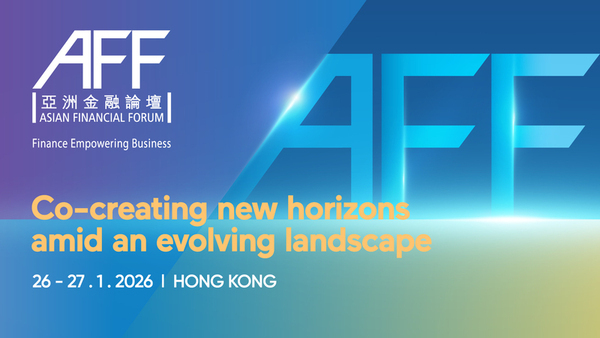
The upcoming Asian Financial Forum (AFF) 2026 will take place on 26 – 27 January 2026. As Asia’s first major financial forum of the year, AFF serves as the region's premier platform that brings together influential leaders from government, finance, and business communities globally for ground-breaking discussions and exchange of insights on the global economy trends from an Asian perspective, while fostering collaboration and building international networks.
Under the theme “Co-creating New Horizons amid an Evolving Landscape”, AFF 2026 will explore how global business communities and policymakers can jointly shape new pathways for growth across geographies and industries in response to shifting dynamics. The forum will also spotlight a series of high-growth industries and innovation, including fintech, new energy, green technology, AI and robotics, web3, and more, while dissecting the connectivity between finance and the real economy, with the goal of driving innovation, regional integration, and sustainable development.
AFF website: https://www.asianfinancialforum.com/conference/aff/en
The Focus
Davos symbolises institutional continuity. Political leaders, central bankers, asset managers, and multinational executives gather to discuss stability, risk, and incremental change. It is a place known for governance.
That is precisely why Elon Musk’s appearance matters.
Not because of the headlines it generated. Not because of the spectacle. But because it represents something deeper: the slow collision between traditional global power structures and the architects of the next technological economy.
Musk built his reputation by standing outside established systems. He challenged regulators, mocked elite gatherings, bypassed institutional processes, and used direct communication channels to shape public narratives. His decision to step onto the Davos stage signals that technology itself is no longer optional.
This moment reflects a broader pattern unfolding across finance, energy, transportation, and artificial intelligence. Innovation is being pulled directly into policy conversations, trade negotiations, and regulatory frameworks.
The tension is visible.
On one side, institutions still operate on multi-year cycles, committee approvals, and risk containment. On the other, technology leaders move at software speed, driven by iteration, deployment, and scale. When these two worlds meet, friction is unavoidable. But it is also necessary.
Automation, robotics, and AI are becoming economic variables. They affect labour markets, productivity models, supply chains, payments infrastructure, and national competitiveness. Governments cannot ignore them. Markets cannot price them in abstract terms anymore.
This is where Davos becomes relevant again — not as a symbol of elite consensus, but as a pressure point where old systems confront new realities.
Musk’s appearance illustrates that transition. A figure who once dismissed institutional forums now participates in one of the most influential global stages.
The deeper question is not whether robots will outnumber humans, or how fast autonomous systems will scale. The real question is how societies adapt when technological power concentrates faster than regulatory frameworks can respond.
For fintech, financial services, and digital infrastructure, this shift is already visible. Automation reshapes credit decisions. AI changes compliance workflows. Robotics influence logistics and payments. Policy debates increasingly revolve around technology, not just economics.
You can read the full analysis below:
Your Voice Matters
Share your insights with us!
🚀 Join over 6,000 fintech professionals staying ahead of the curve.
Follow FinTech Weekly for expert insights & industry updates!
Sign up for our free newsletter!
Every week we curate significant and impactful stories from the global FinTech Communities - Get our weekly News and Event update

Recent News
PSD2: The Implications for Banks and Online Businesses
David Ramm & Philip Stone
On 8 April 2015, Jamie Dimon, Chairman and CEO of JP Morgan, wrote to shareholders with the following caution: “Silicon... Full Article
When Instant Payments Meet Digital Dollars
Murray Spark

Stablecoins have liquidity but lack distribution. Connecting digital dollars to instant payment rails is fintech's real execution challenge. Full Article
The Open Ecosystem – How Banks Can Keep Pace with Fintech Disruptors
Mike Camerling

Merchant banks and acquirers have hit a vendor-shaped wall. The lack of choice in payment terminals is crippling banks who... Full Article
Amazon Reviews AI Coding Practices After Outages Draw Scrutiny
Rosalia Mazza

Amazon investigates service outages tied partly to generative AI-assisted coding, as concerns grow about reliability risks in automated software development.... Full Article
The role of blockchain in the Open Banking era
Jed Grant

PSD2 - the second Payment Services Directive - offers European consumers significant control over the use of their personal financial... Full Article
Explore Meetups
FinTech Meetup Europe - Tallinn

Hello Tallinn-FinTech Fans! Let’s start uniting FinTech Founders, Corporates, Developers, and VCs across Europe to share, build and collaborate. The... Read More
Hyperledger Argentina

The Hyperledger Foundation is an open source collaborative effort hosted by the Linux Foundation and created to advance cross-industry blockchain... Read More
FinTech Meetup Europe - Lisbon

Hello Lisbon-FinTech Fans! Let’s start uniting FinTech Founders, Corporates, Developers, and VCs across Europe to share, build and collaborate. The... Read More
FinTech Meetup Europe - Frankfurt

Hello Frankfurt-FinTech Fans! Let’s start uniting FinTech Founders, Corporates, Developers, and VCs across Europe to share, build and collaborate. The... Read More
Citi Accelerator TLV

Come meet like -minded people who are interested in Fintech, have a startup, or are looking for their next idea,... Read More